
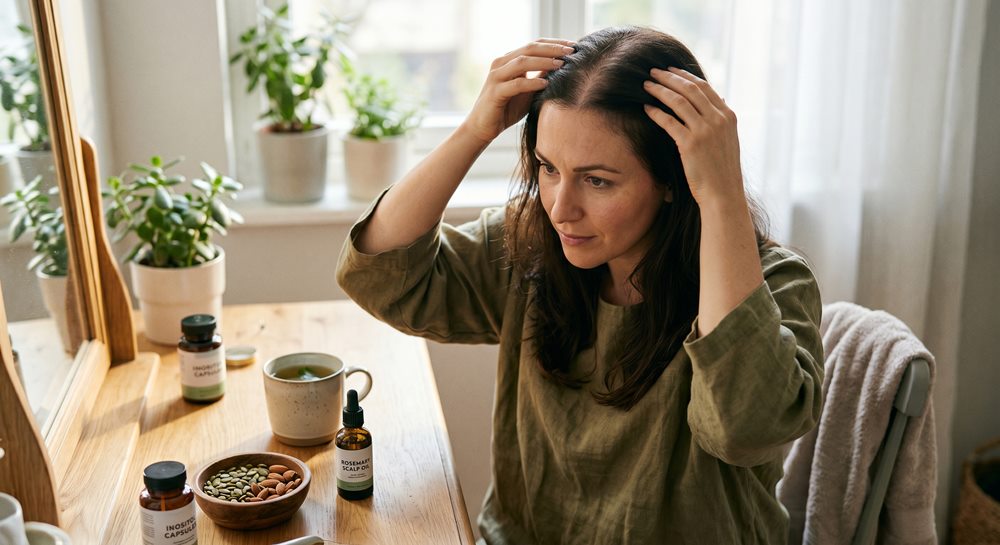
PCOS Hair Loss Regrowth: 10 Tips to Restore Thicker, Healthier Hair
Published: May 2026 | Reading time: 13 min |
Of all PCOS symptoms, hair loss might be the most emotionally devastating. Watching your hair thin at the part, finding clumps in the shower drain, seeing your scalp through what used to be thick hair — it strikes at the core of identity and confidence in a way that blood sugar numbers and irregular periods simply don’t.
But here’s what you need to hear: PCOS hair loss is reversible in many cases. Unlike genetic male-pattern baldness, PCOS-related hair thinning is driven by hormonal imbalance — and when you address the underlying hormonal issues, hair can regrow. It takes time (hair growth cycles are slow), but the evidence is clear: with the right approach, most women see meaningful improvement.
The 10 Regrowth Tips
1 Address Insulin Resistance First
This is the most important step and the one most dermatologists miss. In PCOS, insulin resistance drives androgen overproduction. High insulin signals the ovaries and adrenal glands to produce more testosterone, which converts to DHT at the follicle. If you don’t fix insulin resistance, all other treatments are fighting upstream.
What to do: Follow a low-glycemic, anti-inflammatory diet focused on whole foods, protein at every meal, and minimal refined carbohydrates. Exercise regularly — especially strength training and post-meal walking (see our PCOS workout plan). Consider supplements that improve insulin sensitivity: inositol (myo-inositol 4g + D-chiro-inositol 100mg daily), berberine (500mg 2-3x daily), or discuss metformin with your doctor.
2 Spearmint Tea — Nature’s Anti-Androgen
Spearmint tea is one of the most accessible and well-studied natural anti-androgens for women with PCOS. Clinical research shows that drinking 2 cups of spearmint tea daily for 30 days significantly reduces free testosterone and increases LH and FSH — hormones needed for follicle maturation.
How to use: Steep 1 tablespoon of dried spearmint leaves (or 1 tea bag) in boiling water for 5-10 minutes. Drink twice daily — morning and evening. Be consistent for at least 3 months before evaluating results. This is gentle enough to combine with other treatments.
3 Targeted Hair Growth Nutrients
Hair is metabolically expensive for your body to produce. If you’re deficient in key nutrients, your body deprioritizes hair growth in favor of more critical functions. Women with PCOS are frequently deficient in several hair-essential nutrients:
Iron and Ferritin: Ferritin (stored iron) below 40 ng/mL is associated with hair loss, even if your hemoglobin is normal. Get tested. If low, supplement with iron bisglycinate (gentle on the stomach) along with vitamin C to enhance absorption.
Zinc: Zinc inhibits 5-alpha-reductase (the enzyme that converts testosterone to DHT). Take 25-30mg daily with food. Food sources: pumpkin seeds, oysters, beef, lentils.
Biotin: While often hyped, biotin deficiency is actually uncommon. If you’re not deficient, megadosing won’t help (and can interfere with lab tests). A moderate dose of 2,500-5,000mcg is reasonable.
Vitamin D: Low vitamin D is correlated with hair loss and is very common in women with PCOS. Aim for blood levels of 40-60 ng/mL. Supplement 2,000-5,000 IU daily.
4 Scalp Care with Rosemary Oil
Rosemary essential oil has been clinically shown to be as effective as 2% minoxidil for hair regrowth — with fewer side effects. It works by improving blood circulation to the scalp and may also have mild anti-androgenic properties at the follicle level.
How to use: Add 5-7 drops of rosemary essential oil to 1 tablespoon of carrier oil (jojoba, coconut, or castor oil). Massage into your scalp for 2-3 minutes. Leave on for at least 30 minutes (or overnight with a towel on your pillow). Wash out with a gentle sulfate-free shampoo. Do this 2-3 times per week consistently.
5 Reduce Inflammation
Chronic inflammation damages hair follicles and accelerates the miniaturization process that DHT starts. Women with PCOS have elevated inflammatory markers (CRP, IL-6) that contribute to both systemic symptoms and hair loss.
Anti-inflammatory strategies: Follow an anti-inflammatory diet rich in omega-3 fatty acids, colorful vegetables, and anti-inflammatory spices (turmeric, ginger). Supplement with omega-3 fish oil (2,000mg+ daily). Manage stress (chronic stress is inflammatory). Get adequate sleep (7-9 hours). Reduce or eliminate alcohol, refined sugar, and processed foods.
6 Saw Palmetto — Herbal DHT Blocker
Saw palmetto extract inhibits 5-alpha-reductase, the same enzyme targeted by pharmaceutical DHT blockers. While the evidence is stronger for male hair loss, several studies show benefit for women with PCOS-related hair thinning as well.
What to take: 320mg of a standardized saw palmetto extract daily. Allow 3-6 months for results. Can be used both orally and in topical scalp formulations for combined effect.
Do not use if pregnant or planning to become pregnant. Consult your doctor if taking hormonal medications.
7 Protect What You Have
While you’re working on regrowth, minimize further damage to existing hair:
Use a gentle, sulfate-free shampoo. Sulfates strip natural oils and can worsen scalp inflammation. Avoid tight hairstyles (ponytails, buns, braids) that pull on weakened follicles — this causes traction alopecia on top of hormonal thinning. Minimize heat styling. Air-dry when possible, and use a heat protectant spray when you do style. Use a silk or satin pillowcase — cotton causes friction that breaks fragile hairs overnight. Handle wet hair gently — hair is weakest when wet. Use a wide-tooth comb, never a brush on wet hair.
8 Scalp Massage for Blood Flow
Regular scalp massage increases blood flow to hair follicles, delivering more oxygen and nutrients. One study found that just 4 minutes of daily scalp massage for 24 weeks increased hair thickness. Combined with rosemary oil (Tip #4), it’s a powerful daily habit.
How to do it: Use your fingertips (not nails) to apply medium pressure in small circles across your entire scalp. Start at your hairline, work across the top, down the sides, and across the back. Spend 3-5 minutes. Do this daily — while watching TV, at your desk, or before bed.
9 Inositol — The PCOS Powerhouse
Inositol deserves its own tip because it addresses multiple drivers of PCOS hair loss simultaneously. It improves insulin sensitivity, lowers androgens, reduces inflammation, and supports ovarian function.
What to take: The most studied combination is myo-inositol (4,000mg) + D-chiro-inositol (100mg) in a 40:1 ratio, taken daily. This combination has been shown to reduce free testosterone, improve insulin resistance, and support menstrual regularity. Available as a powder that mixes into water — take half in the morning, half in the evening.
10 Medical Treatments to Discuss with Your Doctor
If natural approaches alone aren’t sufficient after 6 months, several medical treatments can be combined with the strategies above:
Topical Minoxidil (2% or 5%): The only FDA-approved topical treatment for female hair loss. Applied directly to the scalp once daily. Regrowth typically begins at 3-6 months. Must be used continuously — stopping causes regressed hair to fall out.
Spironolactone: An anti-androgen medication that blocks testosterone’s effects at the follicle. Often prescribed at 50-200mg daily for PCOS-related hair loss. Requires monitoring and effective contraception.
Low-level laser therapy (LLLT): FDA-cleared devices (combs, helmets, caps) that stimulate hair follicles with red light. Used at home for 10-20 minutes several times per week. Modest but consistent evidence for improved hair density.
PRP (Platelet-Rich Plasma) injections: Your own blood is drawn, processed to concentrate platelets, and injected into the scalp. Growth factors stimulate dormant follicles. Typically 3-4 sessions, 4-6 weeks apart.
Realistic Timeline for Regrowth
Hair growth is slow — each strand grows approximately half an inch per month, and the hair growth cycle takes 3-6 months to complete. Don’t evaluate any treatment before giving it at least 3-6 months. Here’s what to realistically expect:
Month 1-2: Shedding May Increase
This is actually a good sign — weak, miniaturized hairs are being pushed out to make room for new, healthier growth. It’s called “initial shedding” and it’s temporary. Don’t panic and don’t stop your regimen.
Month 3-4: Baby Hairs Appear
Look closely at your hairline and part. You’ll start to see fine, short new hairs growing in. These are new follicles activating. They’ll be thin at first — this is normal.
Month 5-6: Visible Improvement
New hairs are getting longer and thicker. The part line may appear less wide. Overall hair volume begins to feel fuller. People may comment that your hair looks healthier.
Month 8-12: Significant Regrowth
Continued improvement in density and thickness. New hairs are reaching lengths where they integrate with existing hair. Confidence rebuilding. Ongoing maintenance with key strategies keeps results.
Complete Women’s Health Resource Library
Explore all articles in this series:

Author: Kyren Abbot
Passionate about demystifying women's health, Kyren Abbot is a health contributor focused on holistic wellness. Through her writing, she aims to simplify complex health topics and empower women to thrive in every stage of life