
If you are cramping a few days before your period is due, it is hard not to wonder what your body is up to. Period cramps vs early pregnancy cramps is one of the most common comparisons people search for, because the two can feel almost identical.
The honest answer is that cramps alone cannot tell you which one you are having. But timing, location, intensity and the symptoms that come with them give real clues. This guide walks through each one, shows when a pregnancy test gives a reliable answer, and explains which symptoms mean you should get medical care right away.
Quick answer
- Early pregnancy cramps tend to be milder, felt low in the belly, and may come with light pink or brown spotting. They can appear a few days to about a week before your period is due.
- Period cramps tend to be stronger, can spread to the lower back and thighs, and build up to bleeding that gets heavier.
- Only a pregnancy test can confirm which it is. Testing from the first day of a missed period gives the most reliable result.
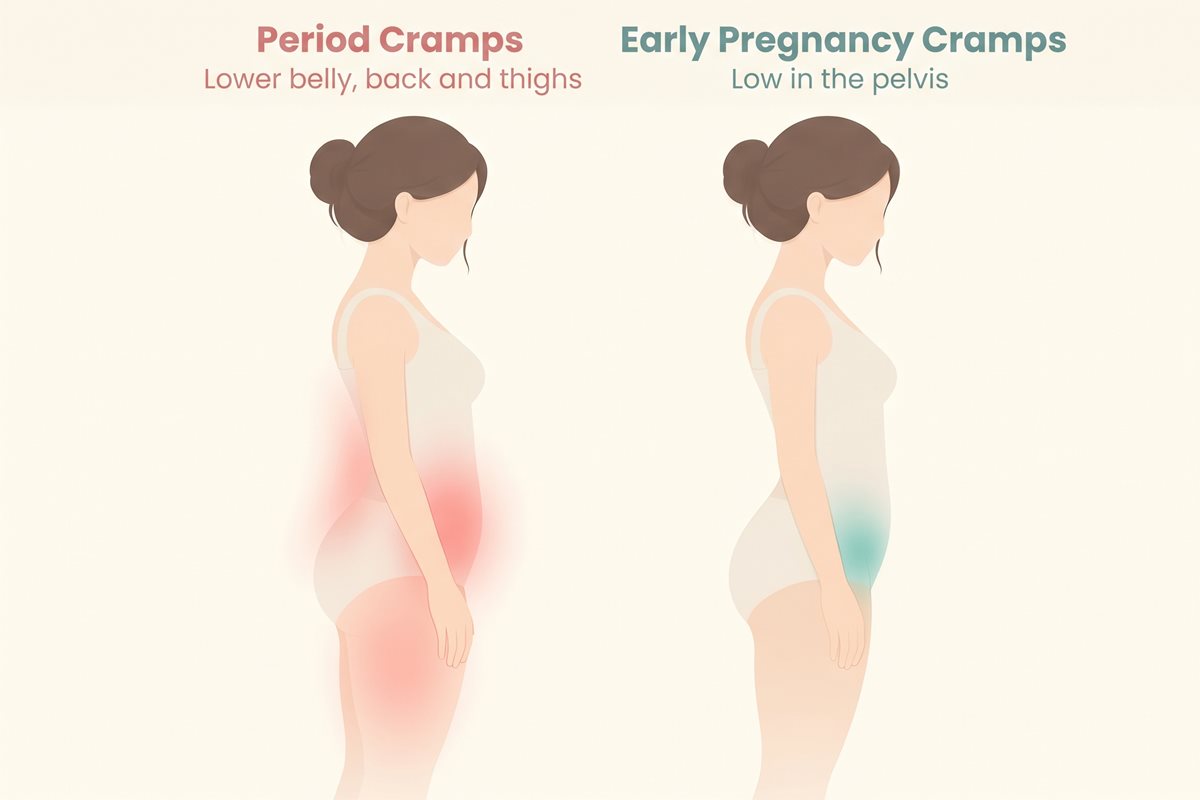
Period Cramps vs Early Pregnancy Cramps: Side-by-Side Comparison
Use this table as a starting point. Every body is different, and some people have no cramps at all in early pregnancy while others have strong ones.
| Feature | Period cramps | Early pregnancy cramps |
|---|---|---|
| Typical timing | A day or two before bleeding starts, and during the first days of your period | A few days to about a week before your period is due, or after a missed period |
| Intensity | Mild to severe, often building over hours | Usually mild to moderate |
| Where you feel it | Lower belly, often spreading to the back and thighs | Lower belly or pelvis, usually without strong back or thigh pain |
| How it feels | Throbbing, dull ache or sharp waves | Pulling, tingling or light twinges that come and go |
| How long it lasts | Usually eases within two to four days of bleeding starting | Implantation cramps are often brief (a day or two); mild cramping can come and go through the first trimester |
| Bleeding | Red flow that gets heavier, may include clots | None, or light pink or brown spotting that does not turn into a full period |
| Other symptoms | Bloating, mood changes, headache, breast soreness that fades once bleeding starts | Breast tenderness that persists, nausea, fatigue, more frequent urination, a missed period |
What Do Period Cramps Feel Like?
Period cramps happen because the uterus contracts to shed its lining. Chemicals called prostaglandins trigger those contractions, and higher levels are linked with stronger pain. That is why period cramps often feel like waves: they tighten, peak and ease.
For most people, period cramps start a day or two before bleeding begins, are strongest around the start of the flow, and ease off over the next few days. The pain often reaches into the lower back and upper thighs. If your cramps usually follow this pattern, it is a decent sign that your period is on its way.
What Do Early Pregnancy Cramps Feel Like?
Cramping in early pregnancy has more than one possible cause, which is part of why it is so easy to mistake for a period.
Implantation cramping
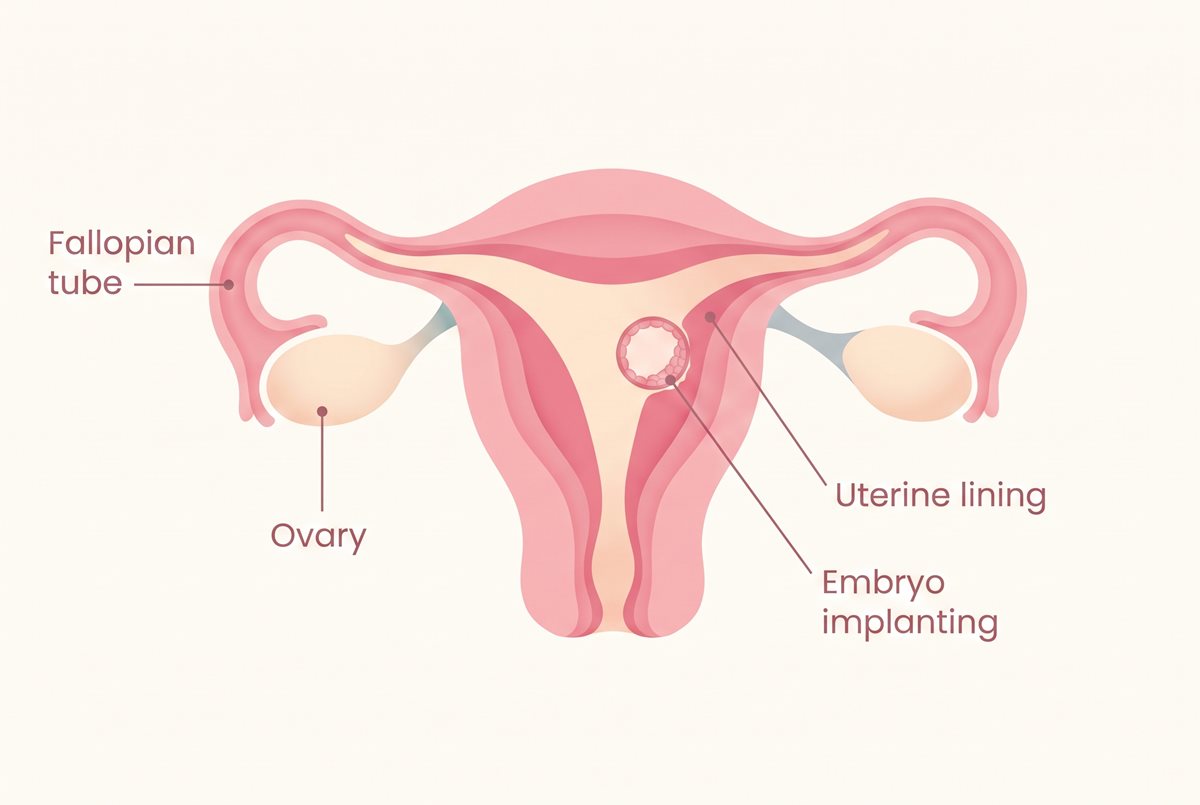
After an egg is fertilized, it travels to the uterus and attaches to the uterine lining. This is called implantation, and it usually happens about 6 to 12 days after ovulation. For many people, that falls a few days to about a week before the period is due.
Some people notice mild cramping or light twinges around this time. Others feel nothing at all. Researchers do not fully understand why implantation causes cramps for some people, and good research on how common it is remains limited. When it does happen, the cramping tends to be lighter than typical period cramps and short-lived, often a day or two.
Cramping as the uterus changes
Once pregnancy is underway, hormones increase blood flow to the pelvis and the uterus begins to grow and stretch. This can cause mild pulling or achy cramps that come and go during the first trimester. Mild cramping like this is common and is often not a sign of a problem.
Implantation Bleeding vs a Period
Some people also notice light spotting around the time of implantation. It is usually much lighter than a period. Typical differences include:
- Color: pink or brown rather than bright or dark red
- Amount: spotting that may show only when you wipe, not a flow that soaks a pad or tampon
- Duration: a few hours to a couple of days, without building into heavier bleeding
Not everyone who is pregnant has spotting, and spotting does not always mean pregnancy, so treat it as a clue, not proof.
Timeline: When Do Cramps Point to Pregnancy or a Period?
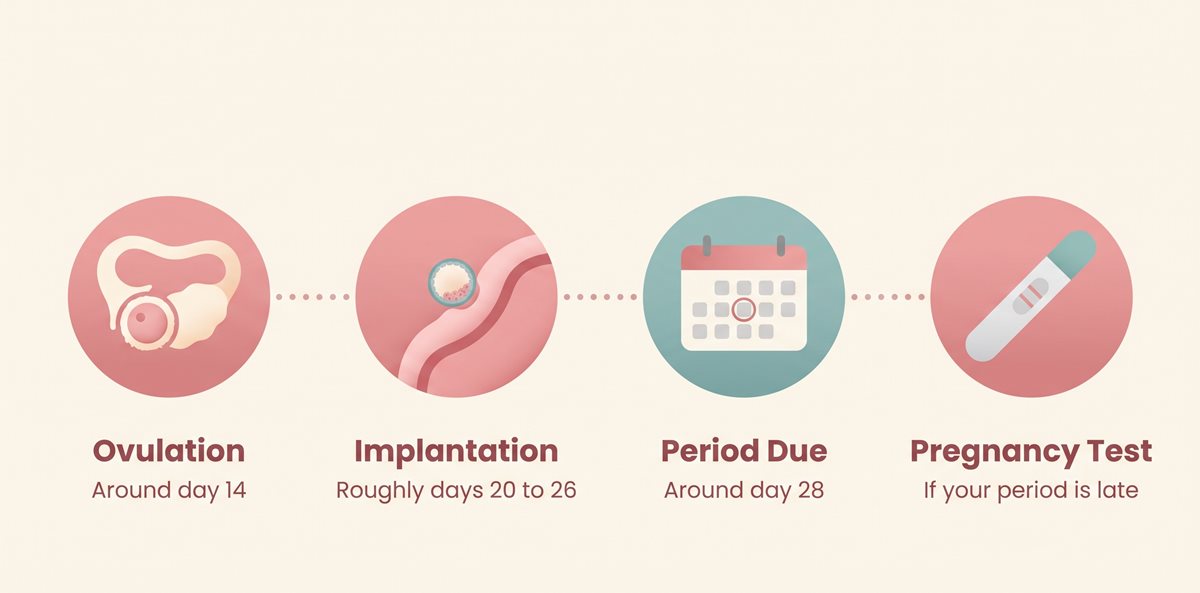
Counting days can help you read your symptoms. Here is a simplified example for a 28-day cycle with ovulation around day 14:
- Around day 14: ovulation. An egg is released.
- Roughly days 20 to 26: if the egg was fertilized, implantation can happen in this window, and some people notice light cramps or spotting.
- Around day 28: your period is due. If it starts, cramps usually build into bleeding. If it does not, take a pregnancy test.
If your cycle is shorter, longer or irregular, these dates will shift. A period tracking app can show how your cycle usually runs, which makes it easier to tell when something is different.
Other Early Signs That Point to Pregnancy
Cramps are only one piece of the puzzle. These signs, especially in combination and alongside a late period, make pregnancy more likely:
- A missed or unusually late period
- Breast tenderness or swelling that does not ease
- Nausea, with or without vomiting
- Unusual tiredness
- Needing to urinate more often
- Food aversions or a stronger sense of smell
Be aware that many of these overlap with premenstrual symptoms, so none of them can confirm pregnancy by themselves.
When to Take a Pregnancy Test
For most people, the most reliable time to take a home pregnancy test is from the first day of a missed period. Tests work by detecting the hormone hCG, which rises after implantation. Some tests are designed to detect very low levels earlier, but testing too early can give a false negative.
If you test early and get a negative result but your period still does not arrive, test again after a few days, or ask a doctor about a blood test. Blood tests can detect pregnancy earlier and more precisely than urine tests.
Other Reasons You Might Have Cramps but No Period
Pregnancy is not the only explanation for cramping around the time your period is due. Other possible causes include:
- Ovulation pain
- Hormonal changes, stress or a change in routine that delays your period
- Ovarian cysts
- Endometriosis or fibroids
- Digestive issues such as constipation, gas or irritable bowel syndrome
- A urinary tract infection
If cramping is severe, keeps coming back or your periods have become unpredictable, it is worth getting checked.
When Cramps Need Urgent Medical Care
Most mild cramping is not dangerous. But some symptoms in early pregnancy can point to a serious problem, such as an ectopic pregnancy, where the fertilized egg implants outside the uterus. This happens in a small percentage of pregnancies and is a medical emergency if the tube ruptures.
Go to an emergency department or call emergency services right away if you have:
- Sharp or severe pain, especially strongly on one side of the lower belly
- Pain in the tip of your shoulder
- Dizziness, fainting or feeling very weak
- Heavy vaginal bleeding
- Pale, clammy skin or a racing heartbeat
Also contact a doctor promptly if you have a positive pregnancy test and cramping that is getting worse, bleeding that is heavier than spotting, or you pass tissue. Mild cramping can be normal, but these changes need to be checked.
How to Ease Cramps Safely
- Use gentle heat: a warm (not hot) heating pad or hot water bottle on your lower belly can help muscles relax.
- Rest and move gently: light walking or stretching can ease cramping for some people.
- Stay hydrated and eat regular meals.
- Check before taking medication: if there is any chance you could be pregnant, ask a pharmacist or doctor which pain relievers are suitable before you take anything, because not all of them are recommended in pregnancy.
Frequently Asked Questions
Can I have period-like cramps and still be pregnant?
Yes. Mild cramping is common in early pregnancy and can feel very similar to period cramps. Cramps alone cannot confirm or rule out pregnancy, so take a test if your period is late.
How long do early pregnancy cramps last?
Implantation cramps, when they happen, are usually brief, often a day or two. Mild on-and-off cramping can continue through the first trimester as the uterus changes. Pain that is persistent or getting worse should be checked by a doctor.
Are early pregnancy cramps felt on one side or both?
They are usually felt in the lower belly or pelvis and can be centered or slightly to one side. Sharp pain strongly on one side, especially with bleeding, dizziness or shoulder pain, needs urgent medical evaluation because it can be a sign of an ectopic pregnancy.
When should I take a pregnancy test if I am cramping?
Testing from the first day of a missed period gives the most reliable result. Testing earlier can produce a false negative. If the test is negative and your period still does not start, test again after a few days or ask a doctor about a blood test.
Why do I have cramps but no period?
Pregnancy is one possible cause. Others include ovulation, hormonal shifts, stress, ovarian cysts, endometriosis, digestive issues and urinary tract infections. See a doctor if the cramping is severe, lasts a long time or keeps returning.
Can cramping in early pregnancy mean a miscarriage?
Mild cramping is common in healthy pregnancies. Strong cramps with heavy bleeding or passing tissue need prompt medical care, so contact a doctor or emergency service if that happens.
The Bottom Line
Period cramps vs early pregnancy cramps can be nearly impossible to separate by feel alone. Timing, intensity, where the pain sits and what other symptoms show up all help, but the only way to know is to take a pregnancy test once your period is late. If your pain is severe, one-sided, or comes with dizziness, shoulder pain or heavy bleeding, do not wait: get medical help right away.
Medically reviewed by [Name, credentials] on [date].

Author: Kyren Abbot
Passionate about demystifying women's health, Kyren Abbot is a health contributor focused on holistic wellness. Through her writing, she aims to simplify complex health topics and empower women to thrive in every stage of life